Critical analysis of Brandie Weikle’s article: “Canada’s top 100 CEOs have already earned more than the average Canadian will all year”
Quick link to my article: https://www.cbc.ca/news/business/canada-top-100-ceo-salary-1.5413124
Money is considered a vital aspect of society, though a vast majority of individuals do not discuss their earnings with others. However, the earnings of Canada’s top 100 CEOs is something that should be talked about. In the article, “Canada’s top 100 CEOs have already earned more than the average Canadian will all year”, Brandie Weikle (2020) discusses and provides evidence to support the evident difference between the earnings of Canada’s top 100 CEOs and the average Canadian worker. By continuing to allow such a significant earning difference, income disparity continues to exist, to which it reiterates and continues to cause inequality for Canadians. To understand the inequality in Canada, it is best to start by analyzing the difference in earnings between CEOs and the average worker.
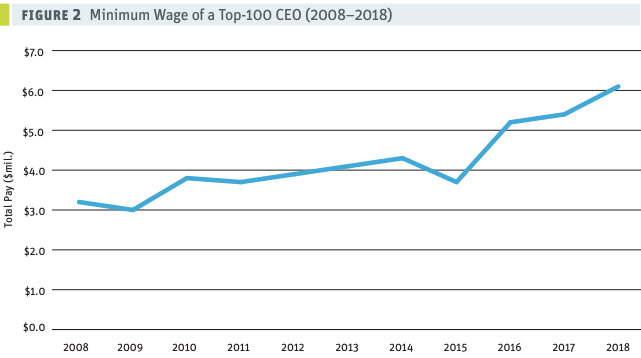
Although there has always been a significant difference between the earnings of a CEO and the average worker, the Canadian Centre for Policy Alternatives (CCPA) believes that the gap is growing larger and more difficult to rationalize. The income disparity between these two groups is the issue being discussed in this article, specifically the difference in earnings in 2018. The earnings that were presented in the article were derived from the CCPA’s annual report on CEO compensation, to which provided clear evidence of income disparity, inequality. They found that the 100 highest paid chief executives earned an average of 227 times more than the average worker in 2018. To put this into numbers, the average annual income in Canada was $52,061 and the top 100 CEOs earned on average, $11.8 million. To further show the earning difference that occurs, the CCPA compares the pay growth between the average worker and a CEO over a 10-year time period. The average worker earned a 24% pay increase between 2008 and 2018, to which seems adequate until it is compared to a CEO. During that same period of time, a CEO earns a 61% pay increase. Shareholders are the ones who are signing off on these big pay bumps, to which they continue to do so because restricting a CEOs pay is difficult because they all know each other, they are all in one small circle. One can then conclude that the wealth in Canada concentrates itself at the very top of the social ladder, while individuals at the middle or lower end of the social ladder are struggling to keep up with inflation.
After reading the article, or such summary, it becomes evident that the average workers are the ones being affected. They are the ones who are bringing home a fraction of what a CEO does and are forced to provide for themselves and potentially others on that minuscule earning (compared to a CEO). The average worker and a CEO will likely view this issue differently. The average worker may deem this earning difference unfair, unequal. Meanwhile, a CEO may deem this ‘issue’, as not an issue as they do not see their earnings as a problem because they are not the ones struggling in regard to money. It also becomes evident that this pressing issue may cause inequality or continue to reinforce them, considering the difference is in regard to money. Money is an aspect that determines where someone goes on the social ladder, to which then determines their ‘worth’ in society. This issue is something that I think can be resolved through employment relations, through regulating their earnings, capping their earnings or having a higher taxation for higher earnings. Information that may be needed to further understand this issue is how is a CEO earning determined… in the sense that, how is their job more deserving of millions than someone who works as cashier or even a janitor? The inequality that resides in Canada becomes very clear after reading this article. Inequality is alive and well in Canada, despite it often being hidden.
References
Canada’s top CEOs have already made more than you will all year | CBC News. (2020, January 3). Retrieved from https://www.cbc.ca/news/business/canada-top-100-ceo-salary-1.5413124
 Abby Nolan's Blog
Hi Abby, what an awesome article to write about and very well written as well! Although the numbers came as quite of a shell shock to me, I cannot say I am all too surprised by the end results. I feel that our economy has found itself in a snowball effect; the rich get richer while the poor continue to suffer.
Your blog post stuck out to me specifically because I recently read an article regarding the existence of the middle class in Canada. More importantly, it fills the income gap discussed in your article. Tencer (2020), specifically discusses how unionization and decline in the manufacturing industry have caused a great deal of pain to middle class households. In addition, they go on to discuss how wages are continuing to drop for both men and women in this sector. I believe this article contributes to the conversation you have started by showing how the income gap is continuing to grow.
I encourage you to take a look at the link to the article I have provided below. But now that we have addressed the problem, how does the Canadian economy attempt to reverse this issue?
Thanks for the read!
Page
Tencer, D. (2020). Decline Of Canadian Manufacturing Means Fewer Men Working, And For Less. Huffington Post. Retrieved from https://www.huffingtonpost.ca/entry/manufacturing-employment-men-canada_ca_5e1f43ccc5b673621f6f1f47.
LikeLiked by 1 person
Hi Page,
Thank you for choosing my blog to comment on, and for saying that my post was very well written, I really appreciate it! I am glad that you liked the article that I chose as much as I did, it really stood out to me compared to the others and for obvious reasons, the actual number comparison between a CEOs earning and the earning of an average worker. I knew that CEOs earned a tremendous amount more than the average worker, but the information and numbers provided, really painted a picture in my head of the reality of it. I agree with your statement, the economy really is concerned and consumed by making the rich richer and making the poor poorer, in the sense the ‘poor’ are not given the same opportunity in life in regard to money (ex. an good and adequate home, clean and accessible water, healthy and nutritious food, clothing for all seasons etc.)
I really liked the article that you encouraged me to read, I agree that it contributes to the conversation I have started. It really shows the impacts how the income gap can grow, not only between individuals who are vastly different on the social hierarchy, but individuals on essentially, the same level.
Thanks for your comment, it really got me thinking. Have a great semester!\
Abby
LikeLike
Hi Abby!
I really enjoyed reading your post! Did you find it as shocking and disheartening as I did to find out how wide the gap truly is? Just as you said, average Canadians are the ones suffering from this growing inequality. Some are forced to work two or more jobs just to make ends meet, while a select few earn more than they know what to do with.
One point you made that caught my eye especially was that wealth “determines where someone goes on the social ladder”. To expand on your point, I thought about how the different intersections of your identity further affect this position. For example, one’s gender identity and racialization can contribute significantly to the opportunities they’re afforded in life, hence why of the 100 CEOs, it is not surprising that only 4 are women (Weinberg 2018). Further, in 2018, only 5.9% of board directors in Financial Post 500 organizations were people of colour (Catalyst 2019). As a broad generalization, I assume several of the CEOs were born into privilege, in a high socioeconomic class that would allow them to pursue the best education possible, have access to vast networks, and cultivate the cultural capital required to achieve their 1% status. They are not subjected to the “other factors” that contribute to black women, for example, only making 84% of what their white female counterparts do, or black men making 74% of their white male counterparts’ wages (Weinberg 2018). These are “permissible wage differences” that stem from seniority, experience, and education, all of which if examined more closely point to larger systemic problems that result in white men making up the majority of the top 1% (ibid).
Policy level changes are necessary to create any substantial improvements to the ever-increasing wage gap, such as a maximum multiple of the lowest paid workers’ wage in determining the highest paid workers’ (ibid). However, further public policy changes are required to address the systemic discrimination contributing to a lack of representation within these positions.
If you get the chance Abby, take a look at this research regarding the demographics of people of colour and women in Canada in 2018 and their workplace representation.
https://www.catalyst.org/research/people-of-colour-in-canada/
Thanks for a great post!
References:
Catalyst. 2019. “Quick Take: People of Colour in Canada” May 28. Retrieved Jan. 30, 2020 (https://www.catalyst.org/research/people-of-colour-in-canada/)
Weinberg, Bradley. 2018. “The Regulation of Wages – Minimums, Living, and Maximums”, June 3. Retrieved Jan. 30, 2020 (https://onq.queensu.ca/d2l/le/content/313831/viewContent/1806621/View)
Weinberg, Bradley. 2018. “The Regulation of Wages – Wage Gaps & The Laws That Target Them”, June 3. Retrieved Jan. 30, 2020 (https://onq.queensu.ca/d2l/le/content/313831/viewContent/1806621/View)
LikeLiked by 1 person
Hi Jamie,
Thanks for choosing my blog to comment on, and for enjoying what I had to say! I couldn’t agree more with you, I was beyond shocked at how horrifically tremendous the wage gap is! Those who are the average workers, really are the ones suffering, especially in regard to money. Although the article imposes that the average wage is just over 50,000, which is likely more than some individuals (those on welfare, working a minimum wage job, on disability or on workers compensation etc)… does not mean that 50,000 is sufficient. In sense that they could too, be struggling with a good and adequate home, clean and accessible water, healthy and nutritious food, clothing for all seasons etc.
I really enjoyed how you added on to the conversation I started, your piece is very interesting and honestly, quite as shocking as the article I chose. I am just as shocked with the information you provided, as I was with the information and numbers that my article provided. The income inequality and the gap between genders and races is quite evident after looking at both of our articles. I think you did an amazing job intertwining what I wrote, your opinions and your other sources. You are a really great writer!
Thanks for your comment, it really got me thinking! Have a great semester!
Best,
Abby
LikeLike
Test Post. Please disregard.
LikeLike